Summit Gear
Minimalist
See your name in every template of this clothing brand logo maker, from boutique scripts to streetwear lettering, and change them as much as you like for free. Our AI can design an original too; pick one that still reads on a neck label.
50 designs, each set with your brand name. Open one to change its fonts, colors and layout. Editing is free; you pay only when you download.
The generator is set to Clothing & Fashion. Type your name, pick a style, choose 2D or 3D, and the AI draws a logo from scratch. Your first AI logo design is free when you sign up.
Examples from our own library. Like a look? Use its style in the generator above.
Minimalist
Gold
3D Clay
More looks in our logo ideas.
Your website gets the attention, but a clothing brand logo does its hardest job inside the collar. A neck label is a strip of fabric an inch or two wide, and your name has to read on it after a year in the wash. Get the logo right there and every other place gets easier.
Where a clothing logo has to work:
Fashion is one of the few trades where a logo without a symbol is normal. Look at the labels on any rack of clothes: most are a name in a carefully chosen font. That's a wordmark, and it makes sense. The clothes are the picture. The label tells people whose they are.
So spend your time on the lettering. A heavy sans-serif reads from across a shop and survives being stitched. A high-contrast serif, the thick-and-thin kind on fashion magazine covers, looks expensive on a bag and loses its hairlines in thread. Our guide on how to choose a font for your logo walks through the main families.
When fashion brands do add a symbol, it's usually a monogram, two initials joined into one shape. One of our AI examples, Maison Laurent, interlocks an M and an L inside an ornamental gold frame. A monogram earns its keep where the full name won't fit, like a button or the cuff of a sleeve. A tiny hanger or needle icon doesn't. It tells people you sell clothes while they're holding your clothes.
An embroidery machine draws your logo with thread, and thread has a thickness. Lines thinner than that disappear, small letters close up and narrow gaps fill in. Every color is another thread, and a gradient can't be stitched at all.
Screen printing has its own rules. Each color goes through a separate screen, so every extra color adds setup work. Gradients and soft shadows get broken into tiny dots, called halftones, which rarely look as crisp on fabric as flat ink.
The answer for both is a flat version of your logo in one or two colors, with no hairlines and no slogan squeezed underneath, plus a white version for dark garments.
In streetwear the logo often is the product, printed big across a hoodie, so it has to look as good at chest size as on the neck label. Blackletter (the spiky, medieval-looking letters) says streetwear at once, which is also why so many brands look alike. If you use it, keep the name short: blackletter turns into a dark smudge sooner than most fonts.
A boutique often stocks other people's labels, so its logo lives on the sign and the bags rather than on the clothes. Scripts and refined serifs suit that, as long as you can still read the sign from across the street.
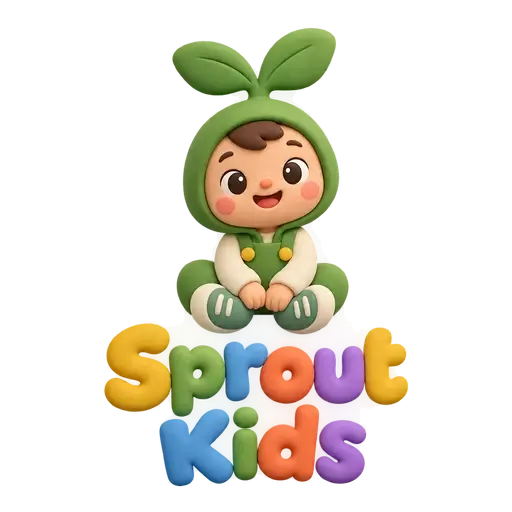
Parents buy, children wear, and a friendly character can win over both. Our AI example Sprout Kids is a smiling clay toddler in a green sprout hood above puffy rainbow letters. Clay is one of the looks our 3D logo maker does, lovely on a website or a shoebox, but it can't be woven into a label. Plan a flat version of the name for the garments.
Mountains are to outdoor gear what paw prints are to pet shops: nearly everyone has one. Our AI example Summit Gear gets away with it because its navy mountain is also the letter S, set over a bold sans-serif that stays readable on a backpack strap. If you use a familiar symbol, give it a second job like that.
Your brand name is already set in every template on this page. Choose one for its layout and lettering, since colors are the easiest thing to change. In the editor you can swap fonts, recolor every element, move or resize each part and open up the letter spacing: widely spaced capitals are a fashion staple. The symbol's shape stays as drawn, so pick one whose symbol fits, or delete it and keep a clean wordmark.
If the logo will be printed large on the clothes themselves, we'd lean toward our AI logo generator further up the page, since a template is a shared starting point and every AI design is a one-off. Choose 2D for anything you plan to stitch.
Before you download, zoom out until the logo is the size of a neck label, then try it on a dark background, which is your black tee. Once you've downloaded the files, our free logo checker repeats those tests and counts your colors. And check your country's trademark register before you print anything: a box of finished hoodies is an expensive place to find a name clash.
Not at first. Most clothing labels are wordmarks, the name set in a well-chosen font, because the clothes already do the picture-making. A symbol or a monogram becomes useful later, for the places where the full name can't fit: a button, a zipper pull, a sleeve, a round profile picture. If a template you like has a symbol you don't need, delete it in the editor and keep the lettering.
Test it at its real size first: a chest logo is often only a few inches wide. If the name still reads that small and the logo works in one or two flat colors, it will usually stitch well. Send the embroiderer the SVG, which they convert into a file the machine can follow (digitizing, in the trade). Ask for a stitched sample before a full run, because thread often looks heavier than the file did on screen.
A vector file, SVG or PDF, so the logo stays sharp at any size, plus a one-color version. Template logos come with both, along with PNG and WebP images for your shop and social media. For an AI logo, a flat style such as Minimalist suits garments, since painted and 3D looks trace into very detailed vectors. If the file types are new to you, our logo file formats guide explains each one.
On screens and packaging, yes: a shiny gold monogram like our Maison Laurent example looks rich on a website or a gift box. Fabric is flat, though. Thread and ink can't show light and depth, and real gold on a hang tag comes from foil stamping, which needs a flat one-color file. Keep the 3D version for screens and photos, and a flat one for everything you sew or print.
With a template, it's possible. Templates are shared starting points, so your name, colors and edits are what make yours different. An AI logo is made for you and never offered to anyone else, which counts for more when the logo is printed across the product. Either way, check your country's trademark register before you print anything.
Browse all logo templates, use our free logo maker, or make a logo with depth in the 3D logo maker.