Logo generator7 min read
Logo Generator vs Designer: Which One Do You Need?
We make a logo generator, and we still think a designer is sometimes the better call. When each one fits, and how to use both without wasting time.
We make a logo generator, so you can probably guess where this article ends up. Mostly you'd be right. But if you're stuck on the logo generator vs designer question for your business, you deserve a straight answer, and the straight answer is that it depends on what the logo has to do. For a lot of new businesses a generator is plenty. For some, a designer is money well spent. Here's how we'd tell the two situations apart.
What a logo generator does, and what it doesn't
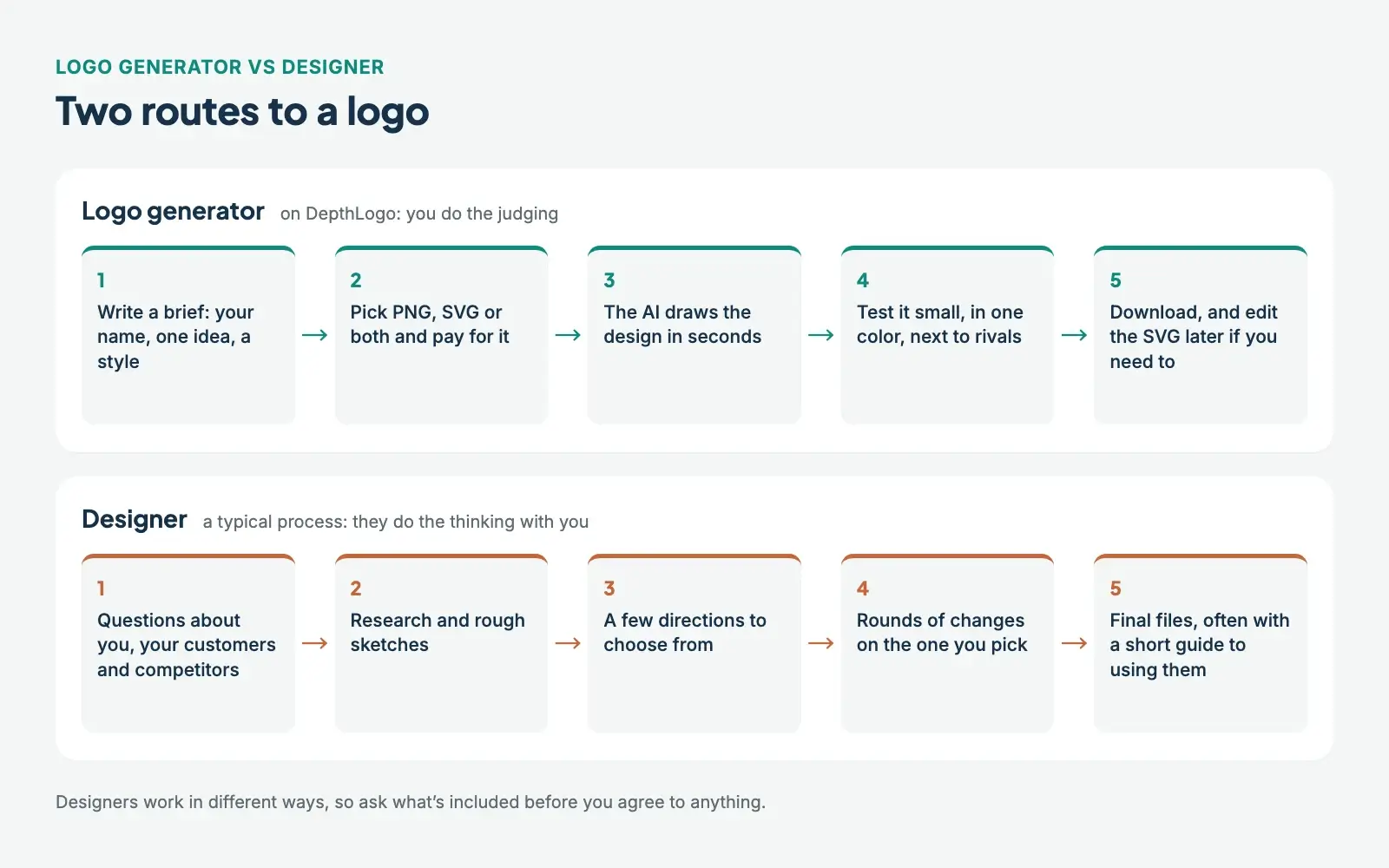
A logo generator turns a short brief into a finished design. On DepthLogo that brief is your business name, an optional slogan, your industry, one line about what the logo should show, a style and your colors. You choose the files you want (PNG, SVG or both), pay for them, and the AI draws the design in seconds. If you bought the SVG, you can open it in our editor afterwards and change the colors and text as often as you like.
There's a second route on our site too. With logo templates you start from a finished layout that already has your name in it, edit it for free, and pay only when you download.
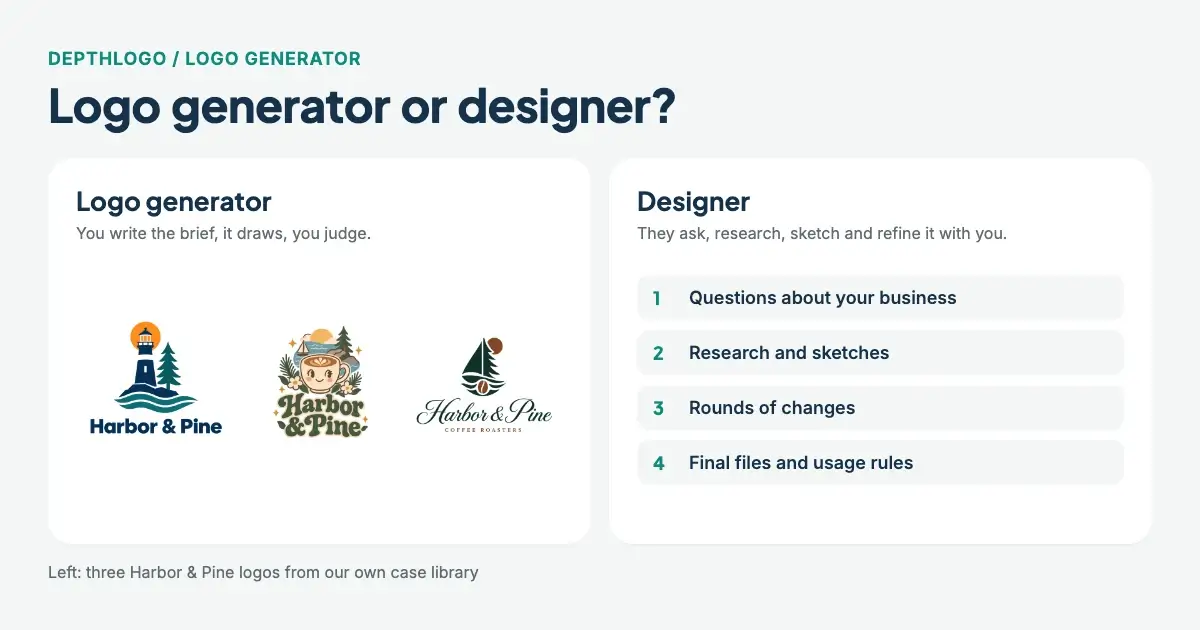
Either way, what you get is speed and range. You can see your name drawn as a lighthouse badge, a cheerful coffee cup and a script wordmark in the same afternoon, and seeing them side by side is often the fastest way to find out what you actually like.
What you don't get is a conversation. The generator doesn't know that your street already has two bakeries with wheat sheaves on their signs. It won't ask why you picked the name, and it won't tell you that your idea for the symbol is a bit off. It draws what you describe, in the style you choose. The judging is yours.
What a good designer brings
When you hire a designer, you're paying for their thinking at least as much as their drawing. A good one starts with questions, about who your customers are and who you compete with. They look at your market, sketch plenty of ideas you'll never see, and come back with a few directions. You pick one, they refine it over a couple of rounds, and you end up with final files, often with a short guide to which colors and fonts to use.
The most valuable part is often the pushback. A designer who tells you "that symbol reads as a pharmacy" before you print it on 500 menus has earned their fee right there.
It also takes longer, usually days or weeks rather than minutes, and it costs more. That's not a complaint. You're paying for a skilled person's time and attention, and good attention isn't cheap.
Designers don't all work the same way. Some sell a fixed package with a set number of concepts and rounds of changes, and others will simply redraw what you describe. Ask what's included before you agree to anything, and ask who owns the files at the end.
When a generator is the better choice
A logo generator makes the most sense when your logo doesn't have to carry much history or much risk yet.
If you're just starting out, your name and even your customers may still change in the first year. A first logo doesn't have to be your forever logo, and it's easier to get a logo right once you know who it's for. If you need something by Saturday for a market stall or a website launch, a designer's timeline won't fit anyway. And side projects, podcasts, clubs, events and small online shops rarely need a full brand system. They need a clear mark that looks decent on a screen and on a sticker.
A generator also fits when you already know what you want. If you can picture the logo, describing it to a generator gets you there faster than describing it to a person and waiting for sketches.
It fits, too, when your money will do more somewhere else. For a new café, a good espresso machine will do more for the business than a perfect logo. We'd rather see you put that money into the things customers notice every day.
When a designer is worth paying for
There are a few situations where we'd tell a friend to call a designer, even though we sell the alternative.
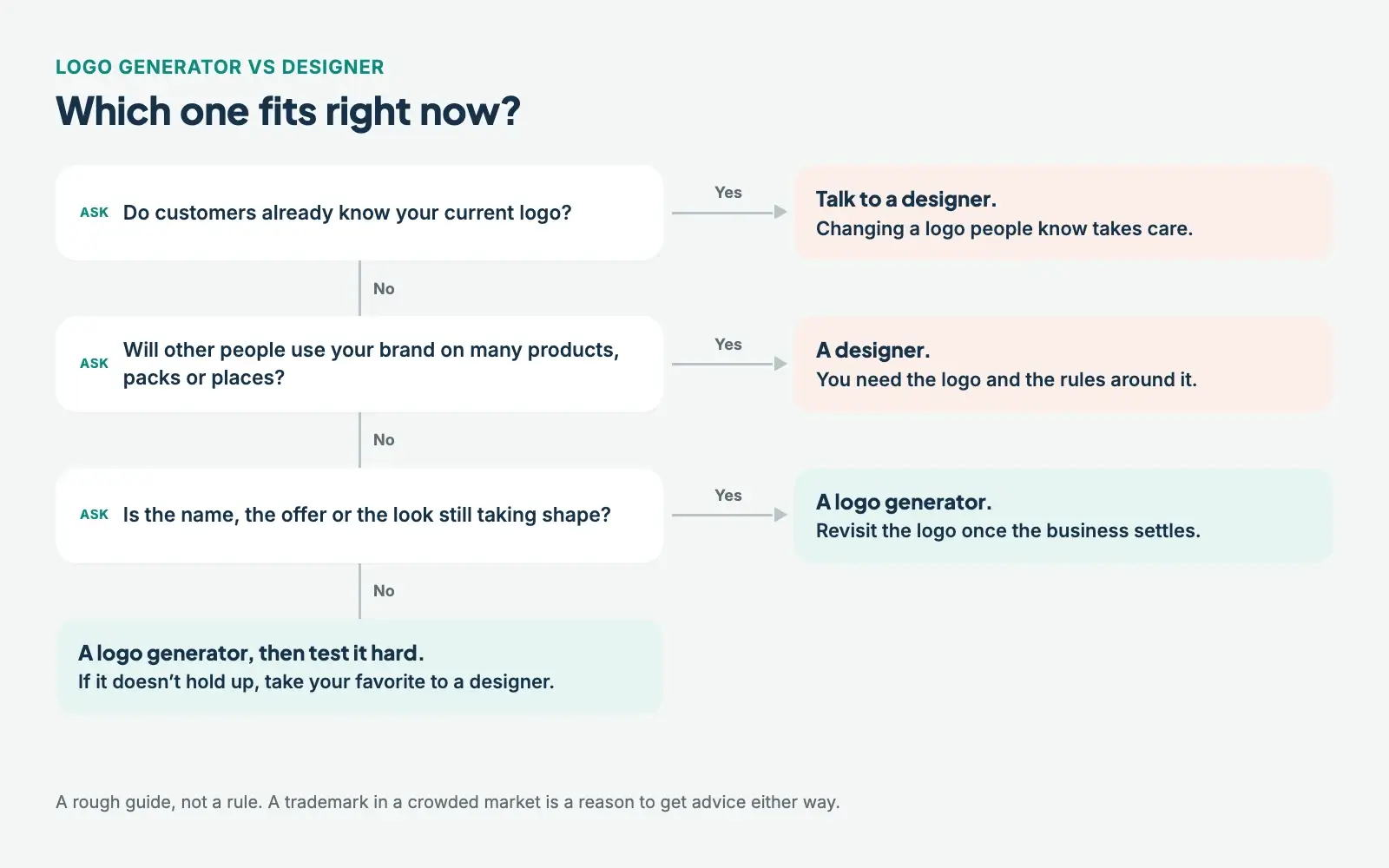
The clearest one is an established business. If customers already recognize your logo, changing it is risky. You want them to feel that the business has grown up, not that it's been sold. A designer can update the old logo carefully, keeping what people know and fixing what doesn't work. A generator draws new designs from a brief. It isn't built to nudge a logo your customers already know.
Then there's the business that needs a system rather than a logo. If you're launching a range of products with packaging for each, or handing your brand to franchisees or a team who'll make their own flyers, you need rules, such as which version goes where and how much space to leave around it. Designers write those rules. A generator hands you a logo and its files, and the rules are up to you.
A crowded market is another. Every purchase on DepthLogo includes a commercial license, so you can use the logo on your website and your products. A license isn't a trademark, though. Whether a trademark office will register your logo depends on what's already registered, and nobody can promise that from a screen. If your brand depends on owning that mark, search your country's trademark register (the USPTO in the US, for example) and get advice before you print it on everything. A designer who knows your field can also help make the logo distinct enough to begin with.
Last, there's the logo that's about to go on something expensive, like a shop front or a fleet of vans. At that point the logo is a small part of what you're spending, and getting it wrong costs far more than getting it right.
You can use both
This isn't a choice you make once and live with forever. A sensible path for many small businesses is to start with a generated logo, then bring in a designer once there are customers, a clearer idea of who the business is for and some money coming in.
You can also use a generator to find your direction and hand the result to a designer to finish. A picture of what you like is far easier to work from than a list of adjectives. "Modern but warm, a bit playful" can mean almost anything. Three logos with notes like "this lettering, that color, a simpler symbol" means something.
If you do that, be upfront about it. Tell the designer where the design came from, send the SVG rather than a screenshot, and let them say what they'd change. Some designers are happy to refine a starting point, and some would rather start from a blank page. Both are fair, so ask before you book.
When the time comes to bring a designer in, give them something to work with: the logo you've been using, a few photos of where it appears, and a short note on what has bugged you about it. That last part is worth more than it sounds. It tells the designer what to fix and what your customers already know, and it keeps a redesign from throwing away the parts that were working.
If you go with a generator, be your own designer
The generator does the drawing, so the designer's other job, judging, falls to you. A few habits make a big difference.
Give it something concrete to draw. "Modern and professional" describes nearly every logo ever made. "A bicycle wheel made of coffee beans" describes yours.
Shrink it. Look at your favorite at the size of a browser tab or a profile picture. If you can't tell what it is anymore, pick a simpler design or plan a simpler second version for the small places.
Try it in black on white. A logo that only works in color, or only with a glow, will struggle on receipts and rubber stamps.
Line it up next to the competition. Find a handful of logos from businesses like yours nearby and put yours among them. If it blends in, keep looking.
Read every letter of your name. A missing letter is easy to miss on screen and impossible to miss on a printed sign.
Buy the SVG if anything will be printed large or stitched. A PNG is perfect for screens, but sign makers and embroiderers will ask for the vector.
Then give it a night. If you still like it the next morning, on your phone and on a printout, you're probably done.
Our honest answer
If you're new or still working out what the business is, use a generator, judge the results the way a designer would, and spend what you save on things your customers will notice. If your logo is about to carry an established name or a trademark in a crowded field, talk to a designer. And if you can't decide, start with a generator. You'll learn what you like, and if you do hire someone later, you'll walk in with a much better brief.